AIRi@UTCN Lecture: Generative Art and Its Fusion of Eastern and Western Styles
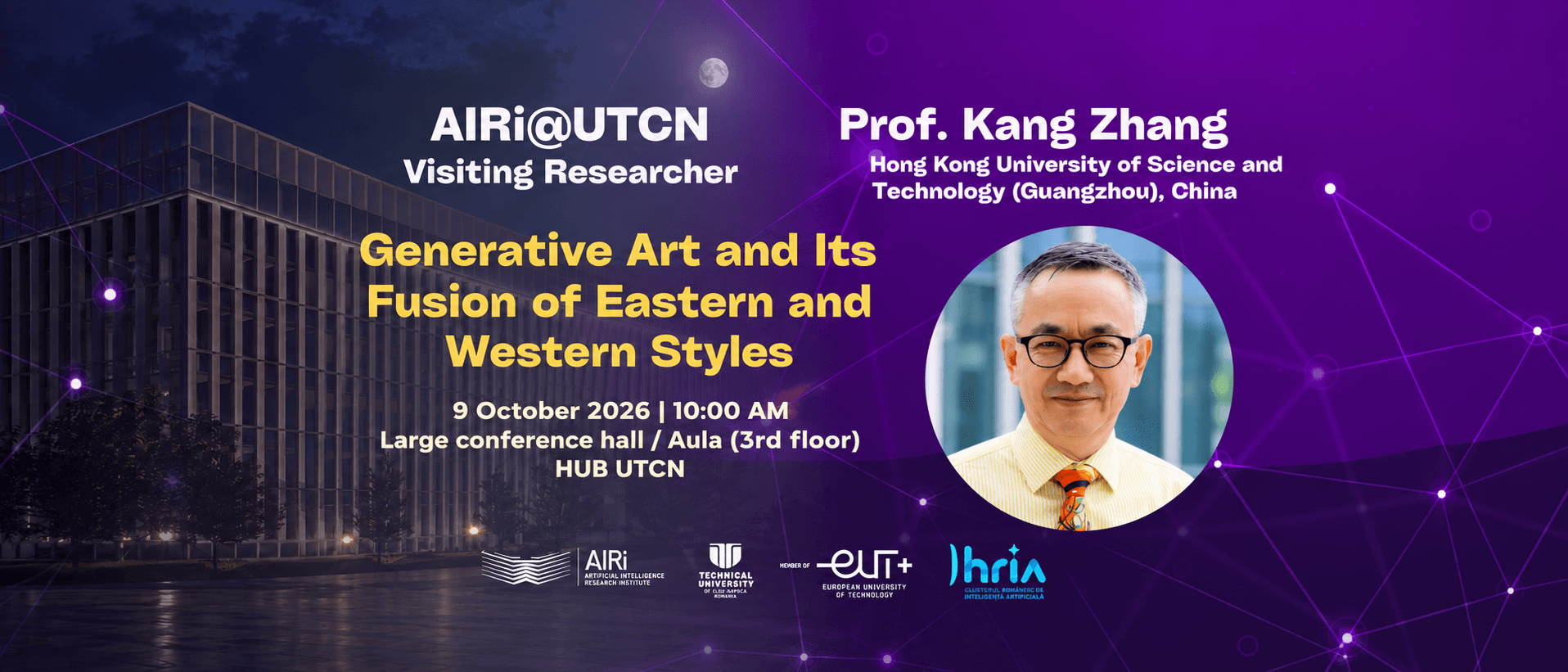
AIRI@UTCN Invited Lecture: Generative Art and Its Fusion of Eastern and Western Styles
Prof. Kang Zhang
Computational Media and Arts, Hong Kong University of Science and Technology (Guangzhou), China
9 October 2026 | 10:00 AM Large conference hall / Aula (3rd floor) HUB UTCN
This event is dedicated to the AIRi@UTCN academic community. Registration is required and available only to participants signed in with a TUCN Microsoft 365 account.
The Artificial Intelligence Research Institute - AIRI@UTCN is pleased to welcome Prof. Kang Zhang for a lecture within the AIRI@UTCN Invited Lectures series.
During his visit to AIRI@UTCN, Prof. Zhang will engage with researchers and members of the wider AIRI community, contributing to academic exchange and interdisciplinary dialogue at the intersection of artificial intelligence, computational media, aesthetics, art and design.
About the lecture
Generative Art and Its Fusion of Eastern and Western Styles
In this talk, I will first focus on conceptual and theoretical foundation of generative art, part of computational aesthetics. Specifically, generative visual art is defined in terms of visual languages, and thus the roles of artists and generative systems become clear. I will then present our recent practices in generative art and design for the effective fusion of Eastern and Western artistic styles. The first practice combines the styles of Wassily Kandinsky and Wu Guanzhong, who are both great masters of using points, lines and planes in their paintings. The AI-fused Eastern and Western styles yield highly aesthetic images. The second practice applies AI techniques to Dongba scripts of the Chinese minority group Naxi in Yunnan Province, and then generates Miro’s surrealism style. Both works have been successfully applied to produce highly demanded design products. Other recent research in computational aesthetics will also be mentioned.
About the speaker
Kang Zhang is Professor and Former Head of Computational Media and Arts, Information Hub, Hong Kong University of Science and Technology (Guangzhou), Professor of Division of Emerging Interdisciplinary Areas, HKUST, Professor Emeritus of Computer Science, The University of Texas at Dallas, and Guest Professor of China Academy of Arts. He was a Fulbright Distinguished Chair and among Stanford’s List of 2023-2025 World’s Top 2% Scientists (Lifetime Impact), and held academic positions in China, the UK, Australia and USA. Zhang's current research interests include computational aesthetics, visual languages, and generative art and design; and has published 8 books, and over 130 journal papers in these areas. He has delivered keynotes at art and design, computer science, and management conferences and forums.
Speakers & Participants

Adrian Petru Groza
moderatorProfessor
Adrian Groza is Professor of Artificial Intelligence in the Department of Computer Science at the Technical University of Cluj-Napoca (UTCN) and Vice-Rector for IT Infrastructure and Digitalisation. He has taught at UTCN since 2004 and has supervised doctoral research since 2019. His courses include Artificial Intelligence, Intelligent Systems, and Knowledge-Based Systems. His research brings together knowledge representation, logical reasoning, ontologies, intelligent agents, and explainable AI. He has applied these methods to medical imaging and ophthalmology, including the identification of retinal biomarkers and systems that combine automated analysis with clinical expertise. His work also addresses misinformation, natural language understanding, and the use of AI in education. He is the author of Modelling Puzzles in First-Order Logic (Springer, 2021), a book that uses puzzles to teach formal reasoning. Beyond research and teaching, Professor Groza contributed as a technology expert to Romania’s national strategic framework for artificial intelligence, including work on AI regulation. At AIRi@UTCN, he helps connect research with the computing infrastructure, institutional partnerships, and opportunities for practical application needed to advance the institute’s mission.

Associate Professor
Privacy Notice: By participating in this event, you acknowledge that photography, audio, and video recording may occur. By entering the event premises, you consent to interview(s), photography, audio recording, video recording and its/their release, publication, exhibition, or reproduction to be used for news, web casts, promotional purposes, telecasts, advertising, inclusion on websites, social media, or any other purpose by AIRi and its affiliates and representatives.