Distributed Systems Research Laboratory
We are exploring artificial intelligence, distributed computing, digital twins, and optimization. We develop intelligent, scalable solutions to real-world challenges in energy, healthcare, industry, and beyond.

Tudor Cioara
Professor
Research Conducted in this Laboratory
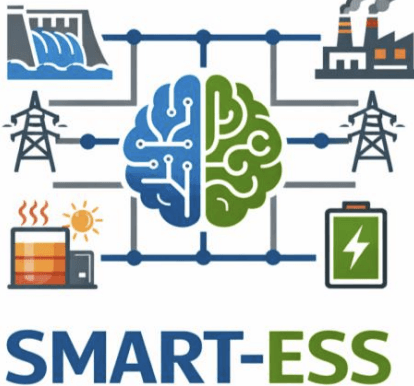
SMART-ESS - Smart multi-layer AI-based resilient twin for advanced control of energy storage systems
Develops, validates and demonstrates at grid scale an integrated control framework for storage systems combining degradation-informed hybrid modelling, multi-service market optimisation, real-time hybrid AI control, and a progressively activated digital twin.
AI.grids
AI.grids is a European initiative to develop common, trustworthy AI foundation models and tools for energy systems, coordinated by CRESYM. It brings together a coalition of TSOs, DSOs, AI developers, technology providers, research institutions, and EU bodies to address the growing need for AI-powered forecasting, control, and optimization of smart grids. The project's core direction is to build and deploy large-scale, sovereign AI models that are aligned with EU regulations and data governance frameworks, leveraging shared data infrastructures and existing platforms like gridFM. Technically, it focuses on designing candidate model architectures, defining training pipelines suited to smart grid data constraints, and engineering the MLOps infrastructure needed to run these models efficiently across distributed edge-cloud environments — all while ensuring privacy, data sovereignty, and compliance with the AI Act.

GenAISIS - A Pan-European Generative AI-based Digital Spine for a Software-defined Interoperable Smart Energy System
Designs, implements and validates an EU Generative-AI-powered Energy Digital Spine (EU-EDS), a software-defined digital backbone that integrates energy assets, data and intelligence into a unified Energy Meta-Operating System.
HEDGE-IoT
HEDGE-IoT is a Horizon Europe-funded project driving the digital transformation of the energy sector through large-scale deployment of IoT technologies across the full grid stack — from behind-the-meter assets all the way up to the TSO level. By infusing intelligence into both edge and cloud layers via advanced AI/ML tools, the project aims to enhance grid resilience, unlock untapped flexibility, and open up new energy market opportunities. The project's core contribution is a multi-dimensional Digital Framework that bridges the cloud/edge continuum and introduces federated applications governed by computational orchestration solutions. This framework is structured around four pillars — Technology Facilitation, Interoperability, Standardisation, and Digital Energy Ecosystem Enabling — ensuring seamless communication, standardised data exchange, and a robust foundation for integrating renewable energy sources at scale. HEDGE-IoT brings together a consortium of 42 partners spanning large ICT companies, research and technology organisations, SMEs, energy stakeholders, EU-level associations, and legal and regulatory experts from 13 European countries. Solutions are validated through six large-scale field demonstrators operating across diverse geographic, climatic, regulatory, and social conditions in Finland, Greece, Italy, the Netherlands, Portugal, and Slovenia. The project also runs two Open Calls allocating €1.7 million to fund up to 30 third-party projects developing complementary data-driven services, extending the framework's reach and fostering broader ecosystem innovation.
DEDALUS
DEDALUS is a Horizon Europe-funded R&I project developing a user-centred, multi-carrier demand response ecosystem for the residential sector. It brings together advanced ICT solutions, social sciences and humanities (SSH) methodologies, sharing-economy principles, and value-stacking governance frameworks to unlock flexibility from residential buildings at scale. EU households account for 27.4% of final energy consumption and are a major driver of peak demand, which today still relies heavily on fossil fuel generation to meet. Greater residential demand flexibility — through smarter load management and consumer engagement — is essential to decarbonising the grid and integrating renewables effectively. To address this, DEDALUS designs, develops, and demonstrates an SSH-driven demand response ecosystem that goes beyond single-carrier approaches, covering multi-commodity scenarios across individual buildings and energy communities. The project combines data-driven modelling, automated DR algorithms and ICT services, participatory design, and new B2B/B2C business models grounded in cost socialisation. Solutions are validated through real-life pilots running across seven European countries, spanning diverse stakeholders and energy contexts. The overarching target is a 15% reduction in overall energy system costs, alongside measurable gains in grid stability, renewable integration, and active participation by residential consumers in energy communities.

HRIA - Romanian HUB for AI
The goal to establish and operationalize the Romanian Hub for Artificial Intelligence (HRIA) for research, development, and innovation in the field of Artificial Intelligence (AI), by developing an attractive and competitive research ecosystem that brings together the efforts of the academic and business environments, with the aim of producing original scientific research, transferring research results to industry and society, developing new products and services, and generating a core of knowledge and development in Artificial Intelligence integrated into the European Research Area (ERA).
SENTHICOM - SENse THInk COMmunicate
UTCN will develop an efficient modeling, simulation, and validation environment, as well as augmented applications associated with the processors created by NXP within the IPCEI framework — the first 5nm automotive processor that safely 'super-integrates' dozens of different critical functions within the vehicle and the most advanced processing platform for the next generation of 4D radar solutions.
EURODRIVES
UTCN advances next-generation automotive electronics and intelligent systems with low-power embedded platforms, computer vision for environment understanding (panoptic video segmentation and depth estimation), emerging microelectronics technologies, multi-physics analysis of automotive electronics, integrated circuit design for driver assistance, and hardware-software co-design validated through novel test platforms and procedures.