Robotics and IoT
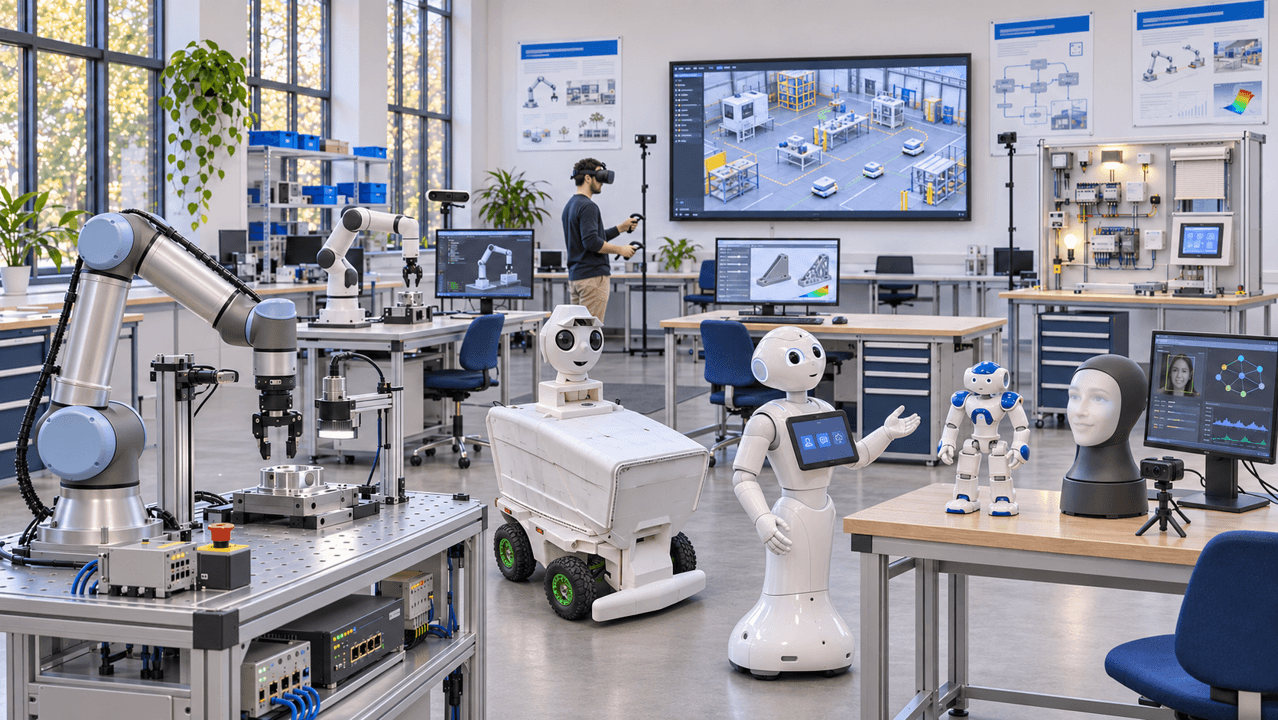
The Robotics and IoT Laboratory focuses on the research and development of Physical AI and Industrial AI for intelligent robotic systems, industrial equipment and manufacturing environments. Its activities address cognitive and collaborative robotics, intelligent manipulation, adaptive automation and human–robot interaction, combining perception, learning, reasoning and control. Particular emphasis is placed on hybrid approaches that integrate physical models, machine learning and symbolic knowledge. Research priorities include physics-informed neural networks (PINNs) for modelling robot dynamics and complex behaviour of industrial processes, together with digital twins for system identification, simulation, virtual commissioning, monitoring and optimisation. Applications include predictive maintenance, multisensor quality inspection, energy efficiency and the adaptive operation of robotic cells and production systems. The laboratory also explores neuro-symbolic and agentic AI for task planning, operator assistance and the coordination of manufacturing resources. The laboratory also explores AI-assisted inventive design, combining generative and neuro-symbolic AI with systematic innovation methods to formulate engineering problems, address design contradictions, and generate and evaluate new concepts for robotic and manufacturing systems. Another research direction is the integration of IoT and Industrial IoT (IIoT) into smart and software-defined factories. This includes smart sensing, embedded and edge AI, industrial interoperability, and the connection of sensors, actuators, robots, industrial controllers and manufacturing information systems. Research investigates how modular architectures, digital twins and software-based orchestration can support the flexible configuration, coordination and reconfiguration of production capabilities. Through applied research, prototyping and experimental validation with industrial partners, the laboratory aims to develop scalable solutions for intelligent manufacturing, while supporting researcher training and technology transfer.

Stelian Brad
Ioan-Valentin Sita
Associate Professor